
The Shocking Link Between Hearing Loss and Falls
Many people do not realize that difficulty hearing can make falls more likely. You are not alone — and the good news is that this is something we can help with. Let us walk you through what the research shows and what you can do about it.
Hearing Loss Makes Falls More Likely — But It Does Not Have To
For a long time, doctors focused on muscle strength, medications, and eyesight when trying to prevent falls in older adults. But a growing body of research has revealed something important — hearing loss is also a significant risk factor for falls, and it is one that can be treated.
Falls are the leading cause of serious injury among people over 65. They can lead to broken bones, hospital stays, loss of independence, and a fear of moving around freely. The emotional toll is just as real as the physical one.
The encouraging news is this: treating your hearing loss is not just about hearing better. It can also help protect your safety, your balance, and your ability to live independently for longer.
51% Greater Chance of Falling
Studies show that people with hearing loss are up to 51% more likely to fall than people with normal hearing of the same age. That is a very significant difference — and it is not just bad luck.
17% Higher Risk Over Time
Even when researchers accounted for age, medications, and other health conditions, people with hearing loss still had a 17% higher chance of falling in the future. The link is real and consistent.
Even Mild Hearing Loss Counts
You do not need to have severe hearing loss for your balance to be affected. Even mild, untreated hearing difficulties have been linked to reduced stability. Many people are unaware their hearing is putting them at risk.
This Is Preventable
Unlike many health risks that come with aging, hearing loss can be treated. And treating it has been shown to reduce falls by up to 65%. This is one of the most actionable steps you can take to stay safe.
Your Hearing and Your Balance Live in the Same Place
Most people think of the ear as something that just picks up sound. But your inner ear actually does two very important jobs at once — it helps you hear, and it helps you stay balanced. Understanding this connection helps explain why hearing loss can affect how steadily you move.
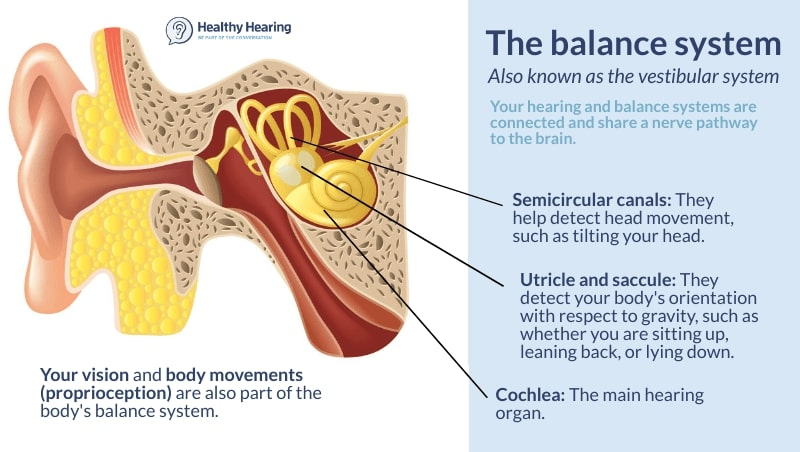
Why Hearing and Balance Share the Same Space
Inside your inner ear, the hearing system and the balance system sit together in the same fluid-filled chamber. They share the same blood supply and connect to your brain through the same nerve — called the vestibulocochlear nerve.
Because they are so closely connected, anything that damages one system often affects the other. This includes normal aging, high blood pressure, diabetes, and certain medications. When hearing starts to fade, balance is very often quietly affected at the same time — even if you have not noticed it yet.
How Your Balance System Actually Works
Your inner ear's balance system has two main parts that constantly send information to your brain:
- Semicircular Canals — Three curved tubes that sense when your head rotates, like when you turn to look at something or shake your head.
- Utricle and Saccule — Small organs with tiny crystals inside that shift when you tilt your head or move in a straight line, telling your brain which way is up.
Your brain combines these signals with what your eyes see and what your feet feel on the ground to keep you upright. When any one of these inputs weakens, staying balanced becomes harder work.
When Both Systems Decline Together
As we get older, both the hearing system and the balance system inside the ear can gradually weaken — often at the same time. Doctors call these changes age-related hearing loss and age-related balance decline.
Because these two systems share the same blood supply, conditions like high blood pressure or diabetes can affect both of them at once. This is why many older adults who develop hearing difficulties also start feeling a little unsteady — even if they have not connected the two things together.
How Your Brain Ties It All Together
Your brain is constantly receiving signals from your ears, your eyes, and the feeling in your feet — and it uses all three to keep you steady. Think of it like a three-legged stool. Each leg supports the others.
When hearing fades, the brain loses one of those legs. It tries to compensate by relying more heavily on the other two. But as we age, vision and foot sensitivity also change — which means the brain has fewer reliable signals to work with, and staying balanced becomes genuinely more difficult. This is not a personal failing. It is simply how the body works, and it is something that can be helped.
Three Reasons Hearing Loss Makes Falls More Likely
It might seem strange that your ears have anything to do with falling. But when you understand what your hearing actually does for your brain, it makes a lot of sense. Here are the three main ways hearing loss increases your fall risk.
Your Ears Help You Stay Aware of What Is Around You
Your hearing works like a quiet security system that runs all day — even when you are not paying attention to it. It picks up the sound of approaching footsteps, a car pulling out of a driveway, or a shopping cart coming around a corner. These sounds give your brain a constant picture of what is happening around you, even outside of what your eyes can see.
When hearing fades, this picture becomes incomplete. You may not notice someone approaching from the side until they are very close, or you may not hear a step change in the floor until your foot is already on it. This reduced awareness gives your body less time to react — and that is when falls happen.
Struggling to Hear Uses Up Mental Energy Needed for Balance
When hearing is difficult, your brain has to work much harder to make sense of the sounds around you. This extra mental effort is real and measurable. The problem is that your brain has a limited amount of mental energy available at any one time.
When a large portion of that energy is spent trying to follow a conversation or figure out what a sound was, there is simply less left over to focus on walking steadily, watching where your feet are going, or reacting quickly if you stumble. This is especially true in busy or noisy places — which are unfortunately the same places where falls often happen.
Your Brain Shifts Its Balance Strategy — and It Can Backfire
When hearing and balance signals from the inner ear become less reliable, your brain starts relying more on the feeling in the soles of your feet to stay upright. For a while, this works reasonably well.
But as we get older, the sensitivity in our feet and legs also gradually decreases. And when you walk on soft surfaces like thick carpet, grass, or sand — or when it is dark — that foot-to-ground feeling becomes much less reliable. At that moment, the brain has no good backup system, and balance can fail suddenly. This is why many falls happen in the evening, on uneven ground, or in unfamiliar places.
How Each Factor Leads to a Fall
A simple summary of the three pathways from hearing loss to increased fall risk
| What Happens | What the Brain Loses | How It Shows Up in Daily Life |
|---|---|---|
| Reduced Environmental Awareness | The ability to sense what is happening around you using sound | Slower reactions to hazards from the side or behind; harder to navigate busy spaces safely |
| Mental Energy Used Up by Listening | The mental bandwidth needed to monitor balance while doing other things | Greater instability in noisy places or when talking and walking at the same time |
| Over-Reliance on Foot Sensitivity | A reliable backup balance system when inner ear signals are weak | Higher fall risk on carpet, grass, uneven ground, or in low light — especially in the evening |
| Shared Inner Ear Decline | Reliable balance signals running alongside hearing | Subtle unsteadiness that may not feel like dizziness but shows up on stairs or in the dark |
What a Major Study Found: Hearing Care Means Fewer Falls
One of the largest and most carefully designed studies ever conducted on this topic — called the ACHIEVE trial — followed nearly 1,000 older adults for three years. What they found gives real reason for hope.
Who Was Studied
977 men and women between the ages of 70 and 84, all of whom had mild to moderate hearing loss that had not been treated. They came from both higher-risk health backgrounds and generally healthy communities across the United States.
How It Was Designed
A rigorous three-year study funded by the National Institutes of Health (NIH). Half of the participants received full hearing care including hearing aids. The other half received general health information. Both groups had the same number of appointments so the comparison was fair.
What the Hearing Care Included
Participants were fitted with hearing aids in both ears by a licensed audiologist. They also received ongoing support, assistive devices where needed, and personal guidance — a complete, real-world hearing care experience.
The Result Was Consistent for Everyone
The 27% reduction in falls was seen in both the higher-risk group and the healthier group. This tells us the benefit of hearing aids for physical safety applies broadly — not just to people with other health problems.
Fewer Falls Over 3 Years
People who received proper hearing care — including hearing aids — fell significantly less often than those who did not. This was a consistent finding across all groups in the study.
ACHIEVE Trial Results — Side by Side
A clear comparison between the two groups in the study
| What Was Measured | Hearing Care Group | No Hearing Care Group | What This Means |
|---|---|---|---|
| Average Falls Over 3 Years | 1.45 falls per person | 1.98 falls per person | 27% fewer falls in the hearing care group |
| Range of Results | Between 1.28 and 1.61 | Between 1.82 and 2.15 | The difference was consistent and reliable, not a fluke |
| Did It Work for Everyone? | Yes — both healthy and higher-risk participants benefited | Higher fall rates across both groups | The benefit applies broadly, not just to one type of person |
| Main Reason It Worked | Better awareness and less mental strain from listening | Continued mental effort from unaddressed hearing loss | More mental energy available for staying safe and balanced |
The More Consistently You Wear Your Hearing Aids, the Safer You Are
Research from the University of Colorado found something very important: the amount of time you wear your hearing aids each day makes a real difference to how much your fall risk goes down. Wearing them here and there is not enough — consistent daily use is what gives you the full benefit.
The Simple Rule to Remember
Try to wear your hearing aids for at least 4 hours every day. That is the level of use that research links to up to a 65% reduction in fall risk. Think of it the same way you think about taking your daily medication or wearing your seatbelt — the protection is only there when you use it consistently. Your audiologist can help you build up gradually if wearing them all day feels like too much at first.
How Signia AX Hearing Aids Help Keep You Safe
Not all hearing aids work the same way. The Signia Augmented Xperience (AX) platform is designed with features that specifically target the reasons hearing loss causes falls — making listening easier, reducing tiredness, and helping you stay aware of what is happening around you.
Augmented Focus™ — Less Mental Effort, More Energy for Balance
Signia AX uses two separate processors working at the same time — one focuses on the speech you want to hear, and the other handles the background noise around you. By keeping these two things separate, the hearing aid delivers speech with much greater clarity, without making you work hard to follow it.
The result? Your brain uses less energy on listening — and that saved energy is exactly what your brain needs to keep you balanced, watch where you are walking, and react quickly if you stumble.
Spatial Sound Awareness — Hear What Is Coming From All Directions
It might seem like a good idea to block out all background noise. But background sound is actually very important for safety — it tells your brain where you are, what is around you, and what is moving nearby.
Signia AX enhances speech while still preserving the surrounding sounds that matter for safety. This means you can hear a car approaching, notice someone walking up behind you, or detect a change in the ground ahead — giving you more time to adjust and stay safe.
Auto EchoShield — Preventing Sudden Sounds from Startling You
Loud, sudden noises — like a door slamming, a trolley clattering, or the echo in a tiled hallway — can cause a startle response. For older adults, even a brief moment of fright can cause a sudden loss of balance.
Auto EchoShield automatically detects these jarring sounds and softens them before they reach your ears. This keeps the listening environment calm and steady, reducing the chance of a startle-related stumble in places like shopping centers, churches, or hospital corridors.
Own Voice Processing — Your Voice Sounds Natural Again
One of the most common concerns people have when they first try hearing aids is that their own voice sounds strange — too loud or hollow. This is not just uncomfortable. It is mentally tiring, and that tiredness adds up over the course of a day.
Signia's Own Voice Processing 2.0 learns the exact sound of your voice and processes it separately so it sounds completely natural to you. This makes wearing hearing aids far more comfortable, encourages you to wear them longer each day, and reduces the mental fatigue that builds up in the afternoon and evening — the very time when many falls occur.
My WellBeing App — Keeping Track of Your Daily Wear Time
We know that wearing hearing aids for at least four hours a day is the key to getting the full fall-prevention benefit. The Signia My WellBeing app helps you and your audiologist keep track of exactly how many hours a day you are wearing your devices.
It also monitors your daily steps and activity levels — giving your hearing care team the information they need to support you, celebrate your progress, and adjust your care plan if needed.
Consistent Daily Wear — Keeping Your Brain Alert and Ready
Beyond any single feature, the most important thing hearing aids do for your safety is keep your brain's hearing system consistently active throughout the day. When your ears are receiving clear, reliable sound, your brain's entire balance and awareness network stays switched on and responsive.
Research suggests that consistent sound input from a hearing aid helps the nervous system respond more quickly to changes in balance — keeping your safety reflexes warm and ready, rather than leaving them unused until a moment of crisis.
Signia AX Features and How They Help Prevent Falls
A plain-language summary of what each feature does and why it matters for your safety
| Feature | What It Does | How It Helps Keep You Safe |
|---|---|---|
| Augmented Focus™ | Separates speech and background noise using two independent processors | Reduces mental effort spent on listening, leaving more brain energy for balance and safe movement |
| Spatial Sound Awareness | Enhances speech while preserving surrounding environmental sounds from all directions | Helps you detect approaching hazards — vehicles, people, obstacles — before they enter your field of vision |
| Auto EchoShield | Automatically softens sudden loud sounds and harsh echoes | Prevents startling noises from causing a sudden loss of balance in tiled or hard-surface environments |
| Own Voice Processing 2.0 | Learns and naturally processes the sound of your own voice | Reduces listening fatigue throughout the day, encouraging longer daily wear and less evening tiredness |
| My WellBeing App | Tracks daily wear time, steps, and physical activity | Helps you and your audiologist monitor whether you are meeting the 4+ hours daily threshold for fall risk reduction |
What the Research Shows — All in One Place
Here is a plain-language summary of the key studies that connect hearing loss to falls — and why treating hearing loss makes a real difference.
| Study | How It Was Done | What It Found |
|---|---|---|
| ACHIEVE Trial (NIH-Funded) | 977 people aged 70–84 followed for 3 years; half received hearing care, half did not | 27% fewer falls in the hearing care group; benefit was seen in both healthy and higher-risk participants |
| Washington University Balance Study | 14 older adults tested on a foam surface in a darkened room, with and without hearing aids | People balanced for 10 seconds longer on average when wearing their hearing aids |
| University of Colorado Population Study | Large group of older adults tracked over time; wear time recorded and analyzed | Hearing aid users were 50% less likely to fall; those wearing aids 4+ hours daily had up to 65% lower risk |
| Purdue University Stability Study | Precise balance measurements taken using force plates, with and without hearing aids | People swayed significantly less and stood more steadily when wearing their hearing aids |
| Cross-Sectional Studies (Multiple) | Large groups of people with and without hearing loss compared at one point in time | People with hearing loss were up to 51% more likely to fall than those with normal hearing of the same age |
| Longitudinal Studies (Multiple) | People with and without hearing loss followed over time and compared | People with hearing loss had a 17% higher risk of falling in the future, even accounting for other health factors |
Common Questions About Hearing Loss and Falls
We know this topic can feel overwhelming. Here are honest, straightforward answers to the questions we hear most often from patients and their families.
Hearing loss affects your safety in three main ways. First, it reduces your awareness of what is happening around you — sounds like approaching footsteps or a change in the ground ahead help your brain prepare your body to stay steady. Second, struggling to hear uses up mental energy that your brain also needs for balance, especially in busy or noisy places. Third, when the inner ear weakens, your brain has to work harder to stay upright — and that extra effort eventually shows up as instability.
Research shows that people with hearing loss are up to 51% more likely to fall compared to people the same age with normal hearing. Even looking ahead over time, people with hearing loss have a 17% higher chance of falling in the future — even when researchers take into account their age, medications, and other health conditions. These are significant numbers that highlight why hearing care is so important for physical safety.
Yes — and there is strong scientific evidence to support this. The ACHIEVE trial, a large study funded by the National Institutes of Health, found that people who received proper hearing care fell 27% less often over three years compared to those who did not. Other research shows that people who wear their hearing aids consistently can have up to 50% lower chances of falling. Those who wear them for at least four hours every day may see up to a 65% reduction in fall risk.
The ACHIEVE trial was one of the largest studies ever conducted on hearing and aging. It was funded by the National Institutes of Health (NIH) and followed 977 men and women between the ages of 70 and 84 for three full years. Half of the participants received complete hearing care — including hearing aids fitted by a licensed audiologist. The other half received general health education. At the end of three years, the hearing care group had fallen significantly less often — averaging 1.45 falls compared to 1.98 falls in the other group. That 27% difference was seen consistently across both healthy participants and those with higher health risks.
Your inner ear does two jobs at the same time — it helps you hear, and it helps you balance. Both systems sit inside the same tiny space, share the same fluid and blood supply, and send signals to your brain through the same nerve. When one system is affected by aging or illness, the other is usually affected too. This is why so many people who develop hearing difficulties also start to feel slightly less steady — even if they have not connected the two things together yet.
Signia AX is designed to make listening easier and less tiring. When listening takes less mental effort, your brain has more energy available for staying balanced and aware of your surroundings. Key features include Augmented Focus, which separates speech from background noise so your brain does not have to do that work itself; Spatial Sound Awareness, which helps you hear sounds from all around you so you can detect hazards before they are right in front of you; and Own Voice Processing, which makes your own voice sound completely natural so wearing the aids is comfortable all day long. The longer and more consistently you wear them, the greater the safety benefit.
Research from the University of Colorado found that wearing hearing aids for at least four hours every day is linked to up to a 65% reduction in fall risk. Wearing them only occasionally does not provide the same level of protection. If four hours feels like a lot to start with, that is completely normal — your audiologist can help you build up gradually and make sure the fit and sound settings are as comfortable as possible so you want to wear them throughout the day.
Yes, it can — and this surprises many people. Balance problems caused by hearing loss do not always feel like dizziness. Instead, you might notice that you feel slightly less steady on thick carpet, in the dark, or on uneven ground. Your brain quietly compensates by relying more on the feeling in the soles of your feet to stay upright. But that backup system is not reliable on every surface, especially as foot sensitivity also changes with age. Many people do not realize their hearing loss is affecting their stability until they have a hearing assessment and begin treatment.
You Deserve to Feel Safe, Steady, and Independent
If you or someone you love has noticed changes in hearing — or has experienced a fall or near-miss — please do not wait. A simple hearing check could be one of the most important steps you take this year. Our team in Honolulu is here to listen, to help, and to make the process as easy as possible for you.
Medical Disclaimer
The information on this page is provided for general educational purposes and is not intended as medical advice, diagnosis, or treatment. The clinical studies referenced — including the ACHIEVE trial and the University of Colorado population research — are peer-reviewed findings cited for accuracy and educational value. Individual results from hearing aid use will vary. Hearing aids are not a direct treatment for vestibular disorders and do not reverse inner ear damage. Please speak with a licensed audiologist or your healthcare provider for a personal assessment of your hearing and balance health. Hearing Benefit Services does not guarantee specific outcomes from hearing aid use.
Hearing Benefit Services
A trusted remote hearing care provider. Top-brand Signia hearing aids delivered and fitted remotely — serving all 50 states since 2016.

Resources
Financing Options Signia FAQ Bluetooth Pairing Guide Hearing Aid Guide Pricing & Packages Cleaning Guide TestimonialsContact Us
© Hearing Benefit Services. All Rights Reserved. Serving all 50 states remotely.
Disclaimer: Content on this website is for informational purposes only and does not constitute medical advice. Consult a licensed hearing specialist for diagnosis and treatment recommendations.